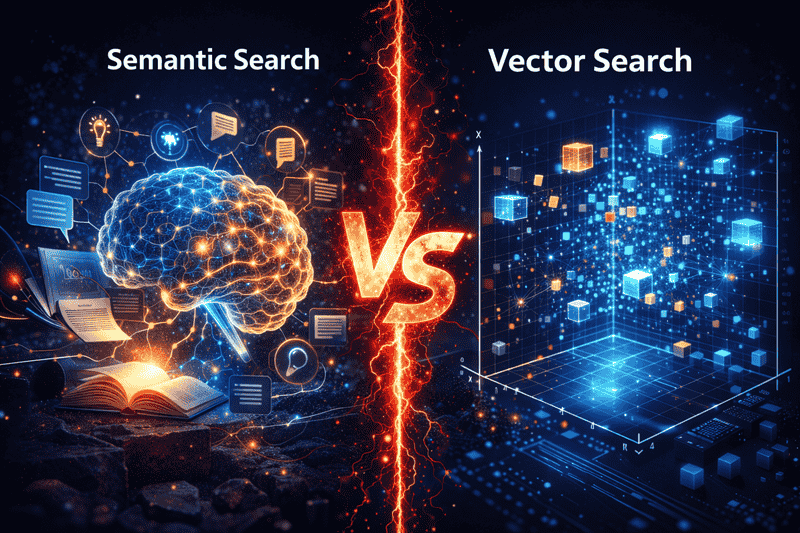
Search has changed a lot over the years. Traditional keyword search used to be enough: type a few words, get matching documents, and hope the exact terms appear in the results. But modern users expect more. They want search engines and AI systems to understand meaning, intent, and context.
This is where semantic search and vector search come in.
These two terms are often used together, and sometimes even interchangeably, but they are not the same thing. Understanding the difference matters if you are building a search engine, an AI assistant, a legal document platform, or any application that needs smarter retrieval.
The simple definition
Semantic search is the broader concept. It means searching by meaning rather than only by exact keywords.
Vector search is a technical method often used to power semantic search. It works by converting text into numerical representations called vectors and then finding the closest matches mathematically.
So in short:
Semantic search = the goal
Vector search = one of the main technologies used to achieve that goal
What is semantic search?
Semantic search tries to understand what the user actually means.
Instead of only matching literal words, it considers things like:
-
intent
-
context
-
synonyms
-
related concepts
-
language structure
-
sometimes even user behavior or domain knowledge
For example, if someone searches for:
“best medicine for headache behind the eyes”
A semantic search system may return documents about:
-
sinus headaches
-
migraine symptoms
-
eye strain
-
pressure pain around the orbit
Even if those exact words do not appear in the query.
That is because semantic search tries to connect the question to the real concept behind it.
What is vector search?
Vector search is more technical.
It takes text such as a query, paragraph, or document and converts it into a list of numbers called an embedding. That list captures the meaning of the text in a mathematical form.
Once both the query and documents are converted into vectors, the system compares them using similarity measures such as:
-
cosine similarity
-
dot product
-
Euclidean distance
The system then returns the vectors that are closest in meaning.
For example:
-
Query: “How do I renew my driver’s license?”
-
Document: “Steps to update an expired driving permit”
Even though the wording is different, the vectors may be close enough for the system to retrieve the document.
The key difference
The easiest way to understand the difference is this:
Semantic search is about understanding meaning.
Vector search is about finding similarity in vector space.
Semantic search focuses on the user experience and relevance.
Vector search focuses on the retrieval mechanism.
A semantic search engine may use vector search, but it may also include other techniques such as:
-
keyword matching
-
metadata filtering
-
synonym expansion
-
knowledge graphs
-
reranking models
-
business rules
That means vector search is often only one part of a full semantic search system.
Why people confuse them
People confuse semantic search and vector search because in modern AI systems they are closely connected.
When someone builds a search feature using embeddings and a vector database, they often say they built “semantic search.” In practice, that may be true from a product perspective. But technically, what they implemented is vector retrieval as the core engine.
The confusion happens because:
-
vector search often enables semantic behavior
-
many AI products market vector-based retrieval as semantic search
-
the end result feels semantic to the user
Still, they are not identical.
Example to make it clearer
Imagine a legal search platform.
A user types:
“cases about employee dismissal without notice”
Keyword search approach
A traditional system may only find documents containing those exact words:
-
employee
-
dismissal
-
without notice
If a case uses the phrase “termination of employment without prior warning”, it may be missed.
Vector search approach
The system converts the query and case texts into vectors and finds documents with similar meaning, even if the wording differs.
Semantic search approach
A full semantic search system may do even more:
-
use vector retrieval to find meaning-based matches
-
filter by court, year, or jurisdiction
-
rerank results based on legal relevance
-
understand that “dismissal” and “termination” may refer to similar legal ideas
-
prioritize authoritative or recent cases
So vector search helps find similar content, while semantic search is the bigger intelligence layer that makes results truly useful.
Strengths of vector search
Vector search is powerful because it can:
-
find matches beyond exact keywords
-
handle paraphrased questions well
-
work across large sets of unstructured text
-
support AI assistants and RAG systems
-
retrieve relevant chunks from documents for LLMs
This makes it especially useful for:
-
legal research
-
knowledge bases
-
support chatbots
-
enterprise document search
-
multilingual search systems
Limitations of vector search
Vector search is not magic.
It can struggle with:
-
exact filtering needs
-
numeric precision
-
dates, article numbers, and IDs
-
very domain-specific language if embeddings are weak
-
explaining why a result was matched
Strengths of semantic search
Semantic search is more complete as a strategy because it can combine multiple signals.
A strong semantic search system can:
-
understand intent better
-
combine exact and meaning-based retrieval
-
improve relevance with reranking
-
use metadata and filters
-
adapt to business or legal rules
In practice, the best semantic search systems are usually hybrid systems.
Semantic search often includes vector search, but not always
This is an important point.
Semantic search does not have to rely only on vectors.
It can also use:
-
synonym dictionaries
-
ontologies
-
taxonomies
-
knowledge graphs
-
NLP parsing
-
entity recognition
-
rules-based logic
For example, in a medical or legal system, semantic search may depend heavily on controlled terminology and expert-defined relationships, not فقط on embedding similarity.
So vector search is common, but it is not the only path to semantic search.
Which one should you use?
The answer depends on your goal.
Use vector search when you need:
-
similarity-based retrieval
-
smart matching for natural language queries
-
document chunk retrieval for LLMs
-
scalable embedding-based search
Use semantic search when you want:
-
a better end-user search experience
-
intent-aware ranking
-
hybrid retrieval
-
filtering, reranking, and domain intelligence
-
production-grade search quality
In real products, the best answer is often:
Use vector search as one component inside a semantic search architecture.
Best practice: hybrid search wins
For most serious applications, especially professional ones, hybrid search is better than relying on one method alone.
A hybrid system may combine:
-
BM25 or keyword search
-
vector search
-
metadata filters
-
reranking models